
When products are made in large volume, it is impossible to inspect each of them before they are sent out. Meanwhile, a few random checks, without a defined methodology, can let serious defects slip through the cracks. Manufacturers thus require a systematic method of inspection, production quantity, time, and risk.
That structure is provided by statistical sampling. Inspectors test a sample of the production lot based on predetermined acceptance criteria rather than testing the entire production lot. Together with unambiguous defect categorization, this provides a tangible means for buyers and manufacturers to make consistent quality decisions without needlessly slowing down manufacturing.
Understanding AQL Sampling in Manufacturing
Acceptable Quality Limit (AQL) is a statistical sampling principle that determines the number of defects that can be detected in a sample without rejecting a production lot. This does not imply that a certain percentage of faulty products is acceptable. Instead, it offers a uniform method of decision making for inspections based on sample size and set limits.
The first step of Product Inspection is to determine the lot size and choose a sampling plan. The necessary sample is then tested for various forms of fault. The results are compared to the acceptance and rejection numbers established by the sampling standard used and a consistent basis is provided for determining whether or not the lot will pass.
How Defect Classification Works
Not all defects have the same impact. A minor cosmetic defect may not impact the product’s usefulness, but a safety defect could have serious implications for the end user. Defect classification enables inspection teams to differentiate these problems and use different acceptance criteria for each type of defect.
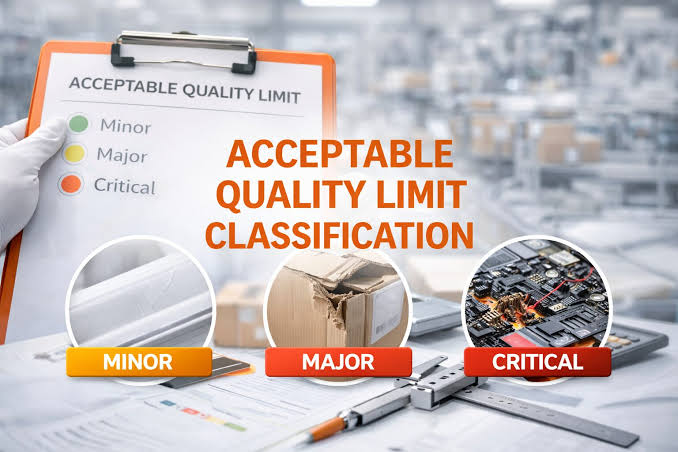
Most quality programs categorize defects into three main categories:
- Critical defects: Defects that may pose a hazard, fail to meet a requirement, or render the product unsafe for use.
- Major defects: Defects which could have a significant impact on functionality, durability, appearance or customer satisfaction.
- Minor defects: Small defects that generally do not impair the function, but are outside agreed specifications.
This classification establishes uniformity among inspectors, manufacturers and buyers. More importantly, it avoids the treatment of minor cosmetic problems as if they were defects that might affect the safety or performance of the product.
Selecting the Right Sampling Plan
The selection of a sampling plan is more than a decision on how many products to inspect. The nature of the approach may be affected by lot size, inspection level, product risk, customer requirements, and past supplier performance. There are standards like ISO 2859-1 that offer a framework for sampling that can help organisations make these decisions in a systematic way.
More stringent inspection requirements or additional testing other than visual testing may be warranted for higher-risk products. A manufacturer of precision parts, electrical equipment, or safety-related products might require a more conservative approach than a manufacturer of consumer accessories that are not safety critical. Sampling should be based on consequences of failure and not production volume.
Combining Visual and Functional Verification
A good sampling program should not be solely based on appearance. Depending on the specification, inspectors may need to assess dimensions, materials, workmanship, functionality, labelling, packaging and other aspects of the product. A product may appear flawless, but may fail in actual operation.
It is particularly critical for products that include mechanical, electrical or electronic elements. Measurements and performance tests can identify problems that can’t be seen in a visual inspection. The use of these techniques in conjunction with statistical sampling gives a more complete picture of the quality of the batches and indicates persistent manufacturing issues.
Common Challenges With AQL-Based Inspection
A challenge is not knowing what AQL means. Some organizations use an AQL value as an assurance that a percentage of the product will not be defective and reach the customer. That’s not sampling! It offers a statistical decision framework and there is always the risk that there are defects outside the sample inspected.
One of the other obstacles is the lack of uniformity in the classification of defects. Without clear documentation of definitions, two inspectors can have different interpretations of the same issue. Variation can be minimised by detailed inspection criteria, photographs, product specification and standardised reporting procedures. Consistency between factories and inspection teams is also ensured through regular calibration and training of inspectors.
Conclusion
A good sampling system provides a viable means for manufacturers to assess large production lots and still have a good control on quality. Combined with good defect definitions and suitable testing methods, AQL methods provide a repeatable structure for making inspection decisions using evidence, not guesswork.
Finally, Quality Control Inspection is much more effective when sampling data is linked to other quality management systems. The aim is not just to turn away faulty goods. It’s to know why defects happen, how to better control manufacturing and how to develop a supply chain that can provide quality at scale.